The creation in Colombo of a rural village with all its vital aspects is unique to the Cinnamon Grand. It provides visitors the chance not only to experience the ambience of rural life without leaving the capital, but also to enjoy typical Sri Lankan cuisine, witness entertainment that reflects the village lifestyle, learn about tradition and culture, and purchase authentic handicrafts.
The village is called Nuga Gama (nuga banyan tree, gama village), the reason for which becomes obvious when you glimpse the enormous banyan, probably two centuries old, that dominates the area.
Maha Nuga
Of the remarkable trees in Sri Lanka, the most awe-inspiring is the banyan (Ficus benghalensis). A fig species, the banyan evolves after seeds dropped by birds land in the crevices of a host tree, germinate, and send aerial roots to the ground. The host succumbs when enveloped with these roots: thus the banyan is called “strangler fig”. A mature banyan is characterized by thick aerial roots indistinguishable from the main trunk that enables the tree to grow extensive, shady canopies, sometimes 200m in diameter.
The banyan, common in both towns and rural areas, is named after Indian traders or banias, who often rested or conducted business under the cooling canopy. In Sri Lanka, where it’s known in Sinhala as maha nuga and in Tamil as arl, it provides an ideal meeting place for villagers. Fortunately, the banyan has no timber or fuel wood value. But the aerial roots are used in Ayurvedic medicine and to make ropes, and the leaves for fodder.
It’s sacred to Buddhists and Hindus. The Buddha achieved enlightenment under a banyan species called the sacred fig (Ficus religiosa), referred to in Sri Lanka as the bo-tree – the Sacred Bo-tree at Anuradhapura is believed to have grown from a cutting of the original tree. In Hinduism, God Shiva is invariably depicted seated under a banyan, which is considered to symbolize eternal life due to its seemingly unending expansion.
The maha nuga that’s the centre of Nuga Gama was originally located in a prime residential area, Captain’s Gardens, which was renamed Maha Nuga Gardens on account of the large banyan tree that stood within the extensive grounds. The maha nuga at Nuga Gama is not that particular tree, nevertheless it is no doubt related, and, as mentioned earlier, it is at least 200-years-old judging by the size and formation of the aerial roots.
The Entrance
Karatta

After exiting the Cheers Pub you follow a path to the left leading to Nuga Gama. The first symbol of village life encountered is a karatha, or cart, the type used for transporting people and goods. Other types still seen today include the elegant carriage, the tirrakale, at the southern town of Matara. In the past there were large carts pulled by a pair of elephants to carry large quantities of rice or heavy equipment.
Vegetable plots & endemic flora

Integrated within Nuga Gama is what is known in Sri Lanka as a “home garden”, which provides vegetables, medicine and useful products. Beside the path, note the cultivation of a variety of Eastern and Western leaf vegetables - lemon grass (sera), pandanus (rampe), curry leaves (karapincha), cabbage, red onion, spinach (nivithi), Indian penywort (gotukola), dwarf copper leaf (mukunuwenna) in addition, endemic flora such as the honey tree or mee (Maduka longifolia) – the bark and seed-oil are used to treat various ailments - the iron wood or Na (Messua ferrea) – the flowers are used as an astringent - and the fish tail palm or kitul (Caryota urens) – the fermented sap yields the alcoholic drink, toddy and an unrefined sugar called jaggery – have been planted to recreate the village environment.
Ambalama

Earlier, when rural people made arduous journeys on foot or by Karatha between villages, it was considered meritorious to provide a shelter where travelers could rest, even stay overnight. Such a structure, an ambalama, is an example of the island’s classic architecture. Fortunately some exist today (there’s one on the Kandy road). The smallest ambalama, represented at Nuga Gama, rests on four stones and consists of four corner pillars and a tiled roof. Larger ambalamas have carved pillars and compartments. No provisions were supplied but water-pots - pintaliya - were regularly filled. The ambalama also served as a gathering place for local inhabitants. Now visitors to the Cinnamon Grand can experience the refreshing atmosphere of this altruistic structure.
Bissa

Once the island was called the Granary of the East thanks to the hydraulic engineers who created magnificent irrigation reservoirs (tanks) to water the sprawling rice fields. The paddy harvests were - and still are in villages - stored in an ingenious structure, the mushroom-like bissa. Circular, but narrower at the base, it consists of a framework of sticks of the kuratiya plant tied by the vines of the eraminya and then plastered with clay. A bissa, which holds around 60 bushels, stands on a wooden platform and has an illuk-thatched roof that can be lifted with a pole for the farmer to store the paddy. To access the paddy there is a door at the bottom so the oldest seed can be removed first.
Pokuna

Another vital element of the village is the pond, or pokuna. The one at Nuga Gama has a delightful bridge and the surface is covered with the blue water lily (Nymphea stellata) or nil manel, which is Sri Lanka’s national flower. It is a symbol of purity and truth, has a sweet fragrance and is offered at Buddhist temples. Villagers use the seeds and tubes as a vegetable, and the leaves, stem and flowers as an herbal medicine.
Gama Gedara

A typical village dwelling, the gama gedera, provides visitors the opportunity to witness the pleasing and functional manner in which villagers live. The gama gedara is a simple structure basically made with clay that has a thatched roof of coarse grass called illuk. Check out the typical wooden furniture and household objects. Near the gama gedera is a well, or Linda.
Kamatha

Harvest is a special occasion, and the threshing floor, or kamatha, becomes the scene of varying rituals to ensure bountiful paddy, the unhusked rice. It starts with the paddy being reaped by the women as they sing special songs. And the sheaves then brought to the specially cleaned kamatha. Sometimes magic circles are drawn, sometimes an arecanut tree planted and magic items deposited. Always the person to whom the paddy belongs will worship and shed the first sheath. The women then come forward and add their sheaves. Buffaloes are yoked together and are driven round and round – often by young boys who talk encouragingly to the animals – till the last grain is extracted.
The kamatha at Nuga Gama will serve as an open space for nightly entertainment. Traditionally the floor provides a stage for Sokari, a drama usually held after the harvest, in which female roles are played by males.
Salawa

The salawa is a traditional hall - at Nuga Gama specifically an area for indoor dining that will also serve as a teaching area for children at weekends. A carefully selected programme will give children the opportunity to gain an insight into Sri Lanka’s arts, culture, crafts, history and traditions.
Kussiya

As the preparation of Sri Lankan food is complex and time-consuming, the kitchen – the kussiya – is always a busy place in the village home. So, inevitably, is the kussiya at Nuga Gama, where the cooks are all gifted village women, so the rural cuisine is truly authentic. It’s a traditional kussiya in every sense. The hearth, or lipa, uses a classic clay structure to raise the cooking pot above the wood-fuelled fire. Above it is a rack, or dummessa, where fish and beef are smoked. Clay pots of different shape and design are used. The nebiliya is a grooved dish that when moved in circular fashion removes grit from rice. The muttiya, to boil rice, has a wide mouth, while the etiliya, to cook curries, is shallow. A kitchen utensil of note is the coconut scraper, the hiramaniya. Come and watch your meal being prepared; delight in the aroma of the spices and the natural, organic scent of the vegetable.
Kade

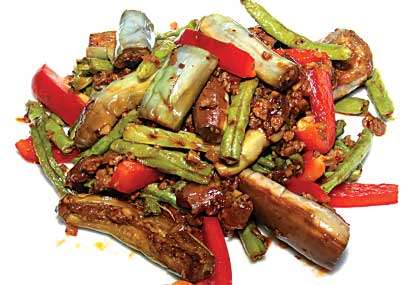
The traditional Sri Lankan shop, the kade, formerly known as boutique (of Portuguese origin), is an integral part of village life. The proprietor, a mudalali, in earlier times invariably wore a banian (vest), sarong and Western jacket - and sported a moustache and konde, a knot of hair at the back of the head. He has always been one of the most affluent persons in the community as the kade is the commercial centre. Therefore it is a more urban structure than the traditional village buildings. Adjacent to the kade is a restaurant serving typical village meals. For breakfast try the kiri kenda with jaggery and an egg curry, for lunch seer fish red curry Jaffna style and watalappam (made from jaggery, eggs and coconut milk) for dessert; and for dinner the crab curry with murunga leaves followed by some delicious local fruit.